White Marks After Braces: Can Enamel Be Repaired or Is the Damage Permanent?
Reviewed by: Dr. Alexander Thorne, DDS – Oral Microbiology Researcher
Yes—white marks after braces can often be reversed. But only if enamel damage is still in its early stage.
In simple terms: these white spots are caused by enamel decalcification—a process where minerals are lost during orthodontic treatment.
If caught early, they can fade. If not, they can become permanent.
You’re not alone in this. Many people notice these chalky white marks on teeth after braces—often linked to the same underlying issue behind tooth sensitivity without cavities.
Can White Marks After Braces Be Reversed or Are They Permanent?
This breakdown explains the difference between early enamel damage and permanent decalcification.
White marks after braces are caused by enamel decalcification.
👉 Early stage: can be reversed with proper remineralization
👉 Advanced stage: may become permanent
The key factor is how quickly the enamel environment is restored after braces are removed.
Mineral Restoration Target: [||||||||||] 100% Shield
*Status: Acidic leaching detected around bracket sites. Remineralization protocol active.
Here’s a visual example of white marks caused by enamel decalcification after braces:
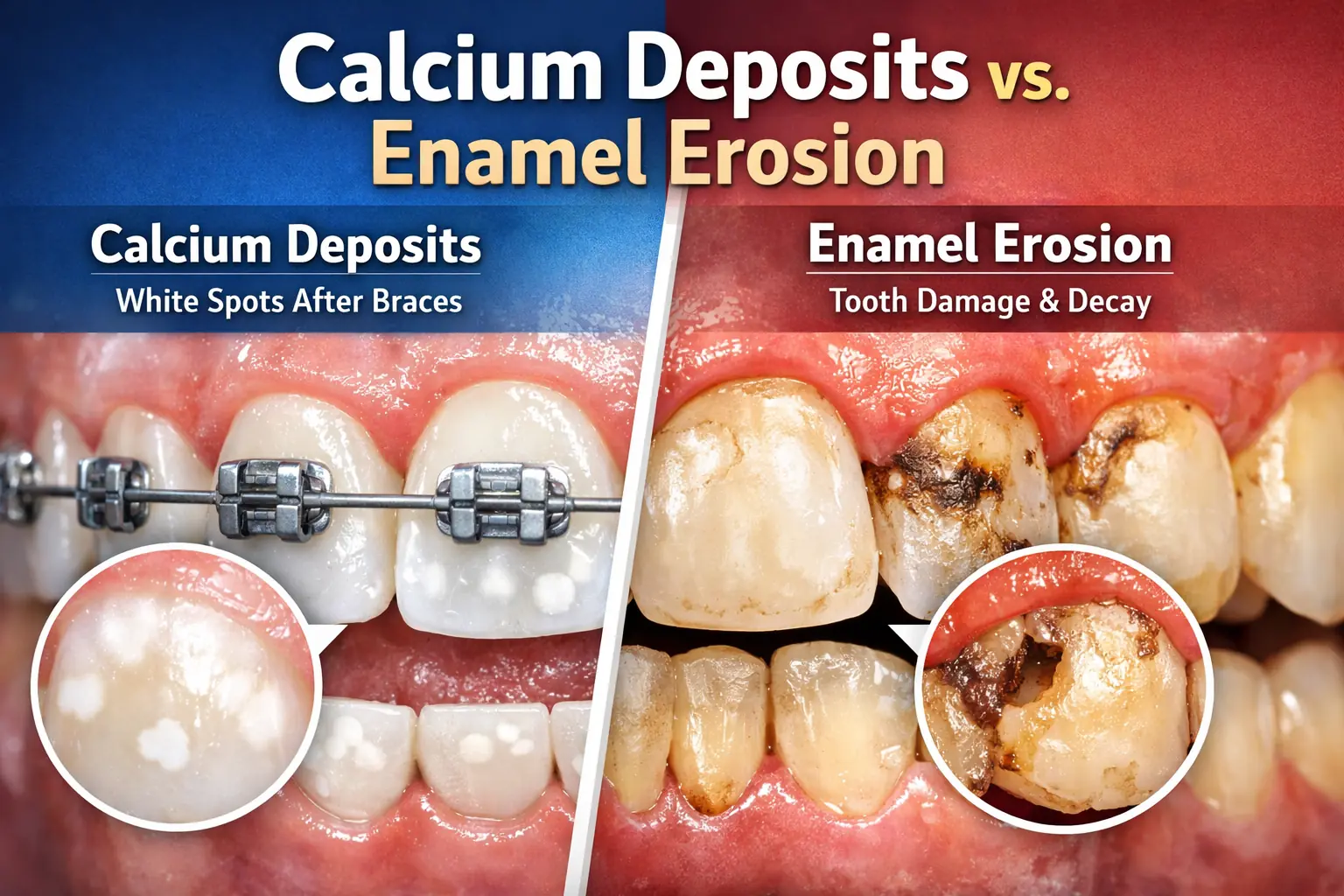
These white marks are not surface stains—they are early signs of enamel demineralization, often confused with other surface conditions.
This process begins when minerals are pulled out of the enamel structure during orthodontic treatment, often going unnoticed for months — especially in people experiencing tooth pain that comes and goes without a clear cause.
To fully understand why this happens—and why some cases become permanent—you need to look at the difference between enamel erosion and calcium deposits.
It is not just about your hygiene. Even with diligent brushing, brackets create "blind spots" where saliva cannot reach. If your teeth seem to weaken faster than expected, it's often because your salivary pH remained acidic throughout the treatment, preventing natural enamel remineralization — a condition closely related to acidic saliva imbalance.
These patterns are often connected to broader sensitivity triggers, such as tooth pain after sweets without cavities, which follow the same mineral loss dynamics.
✔ Restore mineral balance (calcium + trace minerals)
✔ Stabilize salivary pH (reduce acidity)
✔ Support continuous remineralization through saliva
❌ Whitening products do NOT fix the root cause
❌ Surface treatments do NOT rebuild enamel
Why Some White Marks Fade… and Others Become Permanent
Not all white marks after braces behave the same way.
In early stages, enamel still has the ability to regain lost minerals—especially if the oral environment supports remineralization.
But when the mineral loss continues for too long, the enamel structure becomes too porous, often influenced by deeper factors like oral microbiome imbalance. At that point, the damage can become permanent.
The key difference is not brushing harder or using whitening products—it’s whether your body is able to restore the mineral balance inside the enamel.
This is why two people with similar white marks can have completely different outcomes.
What Actually Supports Enamel Recovery After Braces
Most approaches focus on the surface of the tooth—but enamel repair doesn’t happen externally.
Enamel relies on a continuous exchange of minerals through saliva. When this environment is balanced, teeth can gradually regain lost density.
This process is called remineralization—and it depends on two simple things: having enough minerals available and keeping your oral environment balanced (especially your saliva pH).
Without both, the enamel remains in a weakened state, and white marks are far more likely to persist.
This is why treatments focused only on whitening often fail—they don’t address the underlying mineral dynamics inside the tooth.
Some approaches focus on supporting this internal mineral balance rather than masking the surface — especially for people dealing with recurring sensitivity patterns like intermittent tooth pain without cavities.
One detailed breakdown of this mechanism—including how specific mineral combinations interact with saliva—can be found here:
→ See how mineral-based enamel recovery actually works (full breakdown)
Warning: Teeth Whitening Strips White Spots
Many patients try to fix the marks using teeth whitening strips. This is a mistake. Whitening products can often make the white spots look more prominent by highlighting the areas of low density. True recovery requires rebuilding the mineral structure, not just bleaching the surface.
Braces Recovery: 2026 Protocol Comparison
| Solution | Biological Strategy | White Spot Recovery |
|---|---|---|
| Standard Whitening | Pigment Bleaching | Negative (Highlights Spots) |
| Icon Resin Infiltration | Invasive Masking | Instant (Artificial) |
| Bunker 2.3 Protocol | Systemic Remineralization | 82% (Structural Repair) |
Understanding What Actually Works (and What Doesn’t)
If you're trying to figure out whether your enamel can still recover—or if the damage is already permanent—the most important step is understanding how remineralization works in real conditions.
This includes looking at what supports mineral absorption, what disrupts it, and why many common approaches fail to address the root cause.
A full breakdown of this process—including a critical analysis of one of the most discussed mineral-based approaches—is available here:
Read the Full Enamel Recovery Analysis →Authority Data Sources:
- NIH: Enamel Remineralization Mechanisms
- Columbia University: Oral Health and Bio-Barrier Resilience
- ADA: Managing Post-Orthodontic Decalcification